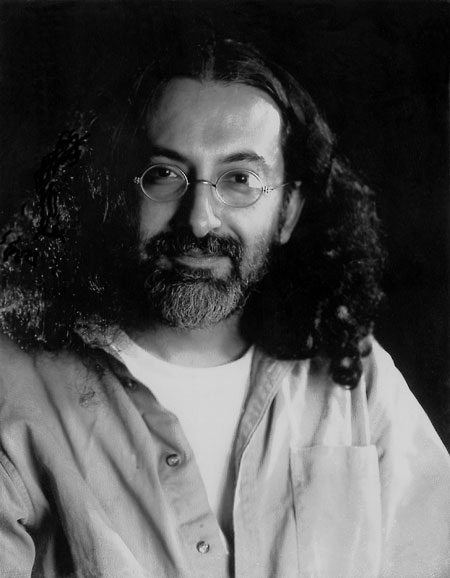
Enrique Chagoya is a Mexican-born painter and printmaker who has been living and working in this country since 1977. Former director of the Galería de la Raza in San Francisco, he has curated exhibitions at the Drawing Center, New York, and the Mexican Museum, San Francisco, among others. His recent shows include the De Young Museum, San Francisco, and David Beitzel Gallery, New York, as well as “American Stories,” now traveling in Japan. His book works are represented in the collections of the Library of Congress and the Whitney Museum of Contemporary Art, among others. Enrique is the recipient of numerous awards and fellowships, including two NEA Fellowships and a Tiffany Foundation Award. He currently teaches at Stanford University.
STATEMENT
I do not know of any other artist’s work that I identify with as much as the work of Guillermo Gómez-Peña. In very general terms, what I do in visual art, he does in performance and/or writing. We mirror each other’s work in different artistic languages. Perhaps the experience of growing up through similar political and cultural contexts both in Mexico and in the US has had an impact on the development of our similar concepts. The differences in our work are only in form, not in content. For Guillermo, the word, the voice, the music, the sound and the performance are some essential raw materials in his world of cultural hybrids and political collisions. In my work, the visual, non-verbal symbolism precedes text. I am most interested in non-alphabetic writing, as is demonstrated in pre-Columbian books.
The writing in the few existing pre-Columbian books is pictographic/phonetic and, in the case of Mayan books, abstract/hieroglyphic. Many Western linguists have based their theories on evolutionist dogma and/or colonialist bias, and have ignored the pre-Columbian writing as pre-phonetic or pre-alphabetic. For me, the pre-Hispanic books are not better or worse than post-colonial books, they are just a product of a specific time and place in history. There is evidence that they were as precise for the cultures that created them as contemporary books are for us. In today’s world we rely on non-verbal and non-alphabetical languages in many important fields. In music, mathematics, traffic signs and maps, text is an accessory to the visual model because alphabetical/verbal language is not enough to communicate the complexity of the subject matter. These forms of texts are clear, precise, concise and profound in many cases. I see the ancient books of Mesoamerica in this light. 1.
Very few books survived the bonfires of the conquistadors. Today only twenty-two pre-Hispanic codex books remain, along with fifty-four others written right after the conquest war by indigenous book artists who were witness to the destruction of their world. The twenty-two surviving books are Mixtec-Zapotec (Oaxaca area), Mayan (Yucatan peninsula/Central America) and Nahua, some of these of Aztec origin (the Aztecs are one among many Nahua groups in central Mexico). The most tragic story is told by Fernando de Alba Ixtlilxochitl, a baptized Aztec noble, in which he describes the destruction of the Texcoco library built by King Nezahualcoyotl, the poet/architect king who opposed human sacrifice. King Neza built the library in the second half of the fifteenth century, a few decades before Columbus arrived in the Caribbean islands. The library of Texcoco was housed in a very large building with dozens of rooms filled with thousands of books of religious, poetic/artistic, medical, calendarial and historic information as well as accounts of yearly, monthly and daily events in the lives of the Aztec people and surrounding cultures. When the Spanish priests and soldiers piled all of these books up and burnt them in huge bonfires, there was a massive indigenous suicide. The surprised Spaniards were unable to stop the Indians from hanging themselves or jumping from high pyramids and cliffs. This kind of story is not included in most textbooks of Western History. History, it has been said, is written by those who win the wars. Yet, there is always the other’s History. In this context, history is an ideological construction, more than a science. 2.
In my codex book concept, I have decided that I am entitled to my own ideological construction. I tell the stories of cultural hybrids, of political collisions of universal consequences, just like Guillermo, but in my case with little or no use of text. The CODEX ESPANGLIENSIS is the first book I have worked on in which the text is as important as the images. Just as in my other book work with Guillermo (Friendly Cannibals, San Francisco: Artspace Books, 1996), ours is a sort of a non-collaborative collaboration, is more of a happy—yet accidental—arrival at the same place. I am not illustrating his text and he is not analyzing my imagery. It is more like we are playing a duet with counterpoint. Felicia Rice is the conductor without whose artistry this book would not have been born. In a very humble way, I do not feel that I am making any contribution to Mexican and Chicano aesthetics or to any aesthetics. I just feel very lucky to get away with what I like to do best, and to be sharing the talent and hearts of two extraordinary partners in crime, Guillermo and Felicia.
Enrique Chagoya
San Francisco / Stanford
1. Boone, Elizabeth Hill and Walter D. Mignol, Writing Without Words: Alternative Literacies in Mesoamerica and the Andes (Durham and London, Duke University Press, 1994), p. 4-26.
2. Martínez, José Luis, Nezahualcoyotl, Lecturas Mexicanas #39 (México: Fondo de Cultura Económica, 1984), p. 296. Also see Portilla, Miguel León F.C.E., Los Antiguos Mexicanos, Lecturas Mexicanas #3 (México: Fondo de Cultura Económica, 1983), p. 60-75.
Return to CODEX ESPANGLIENSIS from Columbus to the Border Patrol