| |
BOOKWORK
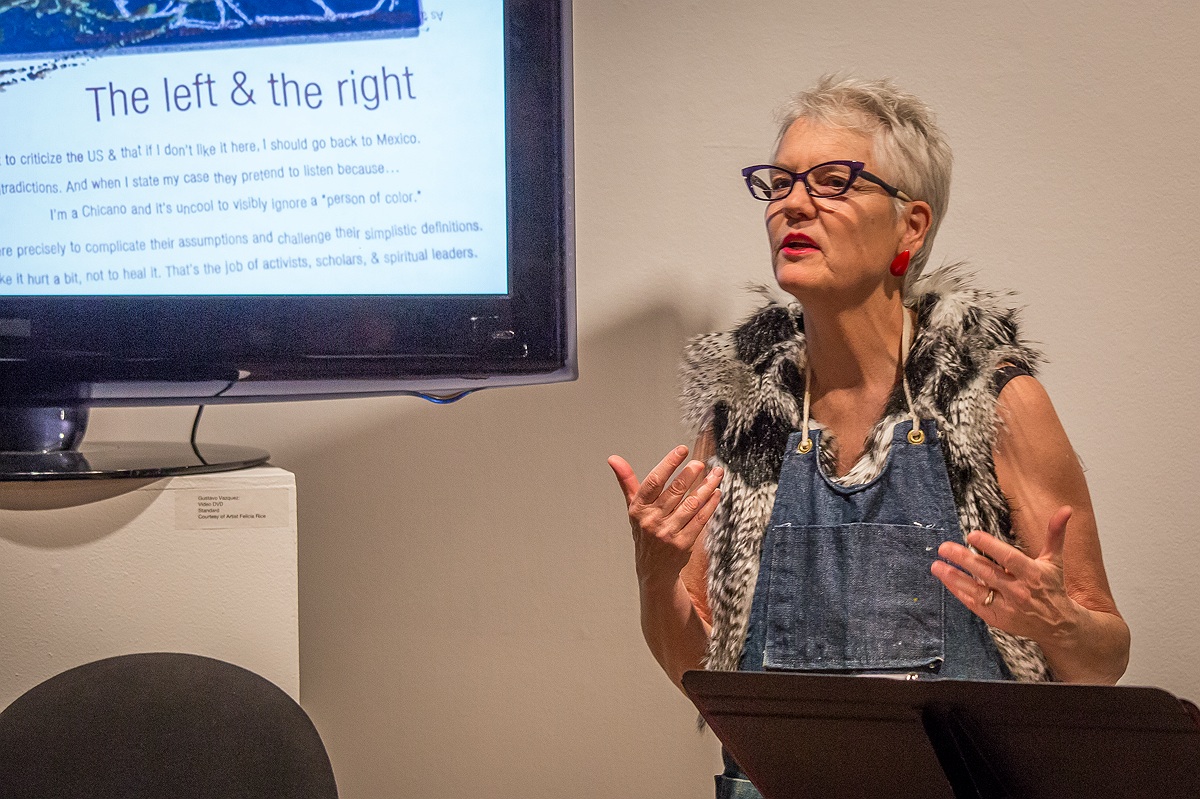
Felicia Rice
Felicia Rice
is a book artist, typographer, printer and publisher whose work has earned her
many honors. She lectures and exhibits internationally, and her books can be
found in collections from the Whitney Museum of American Art to the Bodleian
Library. In the last two decades Felicia has collaborated with and published
some of the finest writers and artists of our time. She has taught extensively
and currently directs UCSC Extension's program in graphic design.
Statement
My parents
met as art students in New York City in the 1930s when the art world was permeated
with the politics of the Depression, the Labor Movement and Left vs. Right.
Family mythology includes the 1949 trip from Vermont to Mexico to apprentice
with the muralist Siqueiros, only to have my sisters, one and four years old,
become so ill that the family barely escaped to the north intact, all this before
I was born. Throughout my life, my parents' circle included former apprentices
of Diego Rivera, and friends of Frida Kahlo. As a young child I would sneak
into my father's studio to study Posada's prints sensationalizing fire, murder,
freakish births. I grew up in California with the legacy of the Spanish land
grants, the Californios, the Mexican muralists and their saints (San Francisco,
Santa Cruz). I am a member of a hybrid community of immigrants and artists;
we use multiple languages.
I set Moving Parts Press
in motion in 1977, the same year that Enrique
and Guillermo embarked on their journeys
of discovery in the United States. In 1991 I published Francisco X. Alarcón's
book of homoerotic love sonnets, De amor oscuro/Of Dark Love, the first
book in the Literatura Chicana/Latina Series. At that time, Francisco mentioned
that Enrique Chagoya and Guillermo Gómez-Peña might be receptive
to a collaborative book project, and in October 1992, my proposal found immediate
resonance with them. In June 1993, Enrique's artwork, fifteen two-color double-page
spreads, and a series of Guillermo's performance texts and poems arrived. In
April 1995, I presented a prototype page and binding of the CODEX to the two
of them. Moving Parts Press had already moved once since the conception of the
book, and I would move 15,000 pounds of type and equipment a second time before
the project was completed in January 1998. During that time Enrique also moved
his studio and home, and married. Guillermo moved from Santa Monica to Brooklyn
to San Francisco and traveled thousands of miles performing on several continents
in the five years it took to complete the CODEX ESPANGLIENSIS.
The CODEX grew to dominate
my efforts at Moving Parts Press. The Press, which had been a public place with
clients and students coming and going daily, became a private studio devoted
to the development of a monumental work. The CODEX shifted the emphasis of my
book work from the literary to the sculptural, drawing upon models of the Mesoamerican
codex, western European bookmaking and Japanese binding structures.
Enrique's collage images
juxtapose examples of graphic art from pre-Columbian times to present-day Mexico
with traditions of Western art and contemporary American pop culture. Guillermo's
texts are scripts for performance pieces and poems written in Spanish, English
and Spanglish, among other languages. The CODEX preserves early excerpts of
his scripts, some of which have since been reworked and published in his 1996
book, New World Border. Text and image share consistent themes: the commodification
and trivialization of culture, the tragi-comedy of life on the fringes of contemporary
society. My challenge was to integrate Enrique's and Guillermo's work
into book form, to create a thoughtful amalgam of text, image, paper,
binding structure, typography and meaningful content
an integrated, harmonious
whole.1
I analyzed the fifteen compositions
for visual sequence, meaning, and their direct relationship to the manuscript.
Some of the two-foot spreads were self-contained, while others suggested movement
to another spread in the collection. Some texts were short and discrete, others
ran to several manuscript pages. Grouping these, I established correspondences
between visual dynamics, meaning and text length.
I based the skeletal structure of each double-page spread on Enrique's
imagery; type formed the ligaments and musculature, binding together and moving
the whole forward. I narrowed my type choices to a handful out of hundreds of
digital fonts, along with my own library of metal typefaces inherited from Sherwood
Grover, and the collection of nineteenth-century wood types generously loaned
by Gary Young. Contemporary type technology presented an opportunity, a temptation
and a challenge: I wrapped, stretched, distorted and tortured type into an expressive
visual component that interacts with the imagery, and with the hand-drawn lettering
and the fonts pre-existing within the artwork. In the finished work, lines extend
to awkward, wobbling lengths, then squeeze into incidental negative space. In
several places the text forms an even texture, a pattern interwoven with images
to reinforce their shape, line and dynamic, without concern for readability.
The book opens to the right in direct contrast to expectation, while the spreads
read conventionally from left to right. Progress through the work is a complex
visual dance, forward and back, sometimes smooth, often jerky, not unlike the
progress of history.
The book was letterpress-printed
on Amatl paper handmade in Mexico using traditional methods dating back over
a millennium. Within each sheet uneven knots of flattened fibers contrast with
tissue-thin areas to create a living membrane with variations in texture and
color. Amatl, also known as Amate (in Spanish) or Mexican bark paper, has long
had great value in Mesoamerica for both spiritual and secular uses. Pre-Hispanic
codices were painted with a brush, rolled or folded away when not in use, and
spread out on soft grasses or mounted on a wall for viewing. In printing the
CODEX ESPANGLIENSIS the Amatl sheets were far too fragile to be ground between
the cylinder of a steel letterpress and raised metal engravings. To strengthen
the printing surface, each page of the CODEX was laminated with Japanese Shintengujo
tissue in a labor-intensive process. In a sense, the printing process forced
a compromise between a native material and a tool of colonization, the printing
press.
The result is a deeply embossed,
richly textured surface that combines the conceptual and theoretical, the political
and personal in a cohesive work that transcends its components. Guillermo Gómez-Peña
writes, "The indigenous philosophies of the Americas remind us that everything
is interconnected, all destructive and divisive forces have the same source,
and all struggles for the respect of life, in all its variants, lead the same
direction. The great project of reform and reconciliation must be, above all,
a collaborative one, and all concerned communities must take part in it." The CODEX ESPANGLIENSIS embodies this spirit of collaboration.
I have been fortunate to
collaborate closely with Enrique and Guillermo and to live intimately with their
work. Special thanks to the California Arts Council and AE Foundation for their
support of this publication, to Elaine Katzenburger and City Lights Books for
their cooperative spirit, to Carol Stoneburner for her assistance, to Maureen
Carey for her continuing interest and advice, and to my family for their love
and forbearance.
Felicia
Rice
Santa Cruz
1. Young, Gary, Dressing the Text: The Fine Press Artists' Book, exhibition catalog (Santa Cruz: Museum of Art & History, 1995), p. 5.
|
|